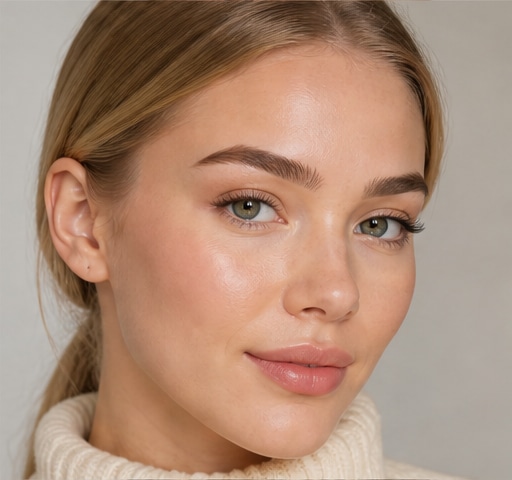
 Try this styleon your selfie · free
Curtain Bangs: How to Style Them for Curly vs. Straight Hair
Published October 28, 2026
The same face-framing fringe behaves completely differently on coils and on pin-straight strands, so here's how to nail it for your texture.
What Curtain Bangs Actually Are
Curtain bangs are a soft, center-parted fringe that's longer on the sides and shorter in the middle, sweeping away from the face like drawn-back drapes. Unlike a blunt fringe, they blend into your length, so grow-out is forgiving and you can wear them tucked or out. The shortest point usually hits between the brow and cheekbone, while the longest pieces graze the jaw. They flatter almost every face shape because that diagonal sweep adds width at the eyes and length below, softening round and square faces and balancing long ones. The big variable nobody warns you about is texture: a cut that looks effortless on straight hair can spring up two inches shorter on curls. That's why the cut and the styling have to be planned around your natural pattern, not against it.
Cutting and Styling for Straight Hair
On straight hair, curtain bangs fall exactly where they're cut, so precision matters and so does volume at the root, otherwise they look flat and stringy. Start by cutting on dry, clean hair a touch longer than your goal since there's no shrinkage to account for. To style, mist the fringe damp, then blow-dry with a round brush: pull each side away from the center and roll the brush outward, hitting the roots first to build lift. Finish with a two-second blast of cool air to set the bend. A pea-sized amount of lightweight cream smooths flyaways without weighing the sweep down. If your bangs go limp by noon, a whisper of dry shampoo or texture spray at the root revives the body. Avoid heavy oils up front; straight hair grabs grease fast and the fringe is the first place it shows.
Cutting and Styling for Curly and Coily Hair
Curls shrink, so the golden rule is to cut curtain bangs longer than you think, often by a third to half the length, and ideally on dry, natural hair so your stylist sees the true spring. Each coil pattern rebounds differently, so dry-cutting curl by curl prevents the dreaded too-short pouf. To style, work on freshly washed, conditioned hair while soaking wet. Apply a curl cream or light gel and finger-coil the front pieces away from your face to encourage that outward curtain sweep rather than a forward flop. Diffuse on low heat, cupping the bangs up toward the scalp to set the part. Once fully dry, scrunch out any crunch with a drop of oil. Refresh on day two by misting water and re-coiling just the front, not the whole head.
Wispy vs. Full: Choosing Your Density
Density changes the whole vibe. Wispy, feathered curtain bangs read youthful, airy, and modern, and they suit fine hair because thin sections won't look sparse. Ask for heavy texturizing and point-cutting so the ends taper into delicate pieces. Fuller curtain bangs, taken from a deeper section back toward the crown, give a heavier, retro sweep that flatters thick or coarse hair and holds a strong shape. If you have fine hair and want fullness, you can fake it by taking the section slightly deeper, but keep the ends soft so it doesn't look like a helmet. For curls, fuller is usually more flattering because sparse curly bangs can separate into gaps. Tell your stylist your daily styling tolerance too: wispier fringes need touch-ups, fuller ones forgive a lazy morning.
The Grow-Out Phase Without the Awkwardness
The best thing about curtain bangs is that they grow out gracefully, but you can make the transition seamless. For the first few weeks, just sweep the lengthening pieces deeper into your part so they blend with the layers around your face. Once they reach cheekbone length, tuck them behind your ears or pin them back with a small clip for an instant off-duty look. Trim only the center point every six to eight weeks to keep the curtain shape while the sides lengthen into face-framing layers. Resist the urge to snip them yourself when they hit your lashes; instead, train them sideways with a round brush or a bit of styling cream. Within a few months they melt into curtain-adjacent layers, which is arguably the most flattering grow-out of any fringe.
Common Mistakes and Quick Fixes
The number one error is cutting wet curly bangs to wet-straight length and ending up with a shrunken micro-fringe, so always factor in shrinkage. On straight hair, the classic mistake is skipping root volume, which leaves bangs glued to the forehead; lift the roots and use cool air to lock the bend. Overloading product up front flattens everything, so keep front styling featherlight. Another miss is styling both sides the same direction, which kills the symmetrical curtain effect, so always sweep each side outward away from center. If your bangs separate into a gap at the middle part, cross-dry them, blowing the right side left and the left side right, then settle them into place to break up the part and add fullness.
The quick checklist
- Cut curly curtain bangs up to half-again longer to allow for shrinkage
- Always sweep each side outward, away from the center, for the true curtain shape
- Blast a two-second cool shot after blow-drying to lock the bend on straight hair
- Diffuse curly bangs while cupping them toward the scalp to set the sweep
- Keep front product featherlight so the fringe doesn't go flat or greasy
- Cross-dry the bangs to break up a gappy center part
- Tuck or clip back grown-out pieces instead of cutting them yourself
- Trim only the center point every six to eight weeks to maintain the shape