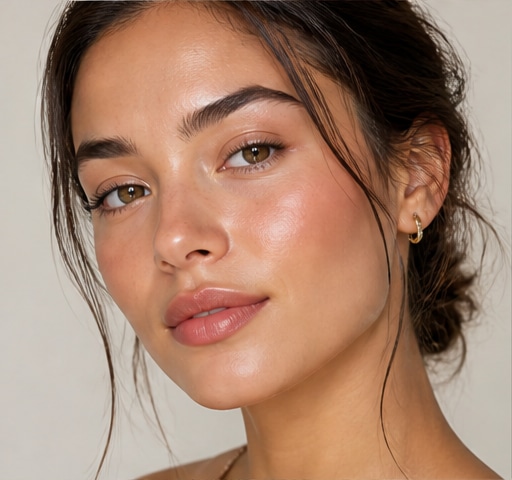
 Try this styleon your selfie · free
How to Choose the Right Foundation Formula for Your Skin
Published September 27, 2026
Match your foundation to your actual skin type and finish goals so it wears beautifully all day instead of fighting your face.
Start With Your Skin Type, Not the Shade
Before you obsess over undertone, identify your skin type, because that decides the formula category. Press a tissue to your face an hour after cleansing: oil on the forehead, nose and chin points to oily or combination skin, which thrives in matte or oil-free formulas. If skin feels tight and shows flaky patches, you're dry and want a hydrating or serum foundation with glycerin or hyaluronic acid. Normal skin tolerates almost anything, so chase the finish you love. Combination skin is the most common, and a satin or natural-finish base usually splits the difference best. Sensitive or reactive skin should favor fragrance-free, mineral-leaning formulas with shorter ingredient lists. Getting this layer right means your base bonds with your skin instead of separating, sliding, or clinging to dry spots within a few hours.
Decode Coverage Levels Honestly
Coverage is a spectrum, and more is not better, it's just different. Sheer or tinted formulas (think a wash of color) even out tone while letting freckles and natural texture show, which reads fresh and modern. Light-to-medium coverage blurs redness and small marks but still looks like skin, the safest everyday choice for most people. Full coverage masks scarring, hyperpigmentation, or rosacea and photographs flawlessly, but it demands more setting and can look heavy in daylight if over-applied. A smart trick: buy medium coverage and build it only where you need it, layering thin sheers rather than one thick pass. If you only have a few spots to hide, a lighter base plus targeted concealer beats a full-coverage foundation everywhere, which often ages the look and emphasizes pores.
Match the Finish to the Look You Want
Finish is the personality of your base. Matte formulas absorb shine and suit oily skin or hot, humid days, but on dry or mature skin they can flatten features and settle into lines. Dewy and luminous finishes bounce light, faking that lit-from-within glow that's all over your feed, ideal for dry, normal, or dull-looking skin, though oily skin may need it set strategically. Satin or natural finish sits in the middle: skin-like, soft, forgiving, and the most universally flattering. A useful guideline is to mismatch slightly on purpose, dry skin plus a touch more dew, oily skin plus a satin rather than a flat matte, so the finish counteracts your skin's tendency instead of doubling down on it.
Get Undertone and Shade Right
Even the perfect formula looks wrong in the wrong shade. Determine your undertone first: veins that look greenish lean warm (golden, peachy), bluish lean cool (pink, rosy), and a mix is neutral. Test shades on your jaw and lower cheek in natural daylight, never your hand or wrist, which rarely matches your face. Apply three close stripes and pick the one that disappears. Remember your skin shifts a half-shade or more between summer and winter, so a single bottle often won't serve year-round. If you're between two shades, size up slightly in summer and down in winter. Curious how a finish or coverage reads on you before you commit, upload a selfie to GlowMaxing and preview makeup looks on your own face so you can compare options side by side.
Factor In Longevity, Climate, and Lifestyle
Your day decides your formula as much as your skin does. Long-wear, transfer-resistant foundations are built for 10-plus-hour days, events, masks, and heat, but they can feel drying and want thorough cleansing at night. Comfort-focused or skincare-hybrid formulas wear 4 to 6 hours gracefully and feel like nothing, perfect for desk days or low-key plans. Humidity breaks down dewy and hydrating bases faster, so reach for oil-control and a setting spray in summer. Cold, dry climates make matte formulas look patchy, so swap to hydrating ones in winter. If you sweat, swim, or work out, prioritize water-resistant wear over a particular finish. Be honest about how much touch-up time you actually have: a fussy base you can't maintain will look worse by noon than a simpler one that holds.
Application Tools Change Everything
The same foundation looks like three different products depending on how you apply it. A damp makeup sponge sheers out coverage and presses product into skin for the most natural, skin-like finish, great for dewy and medium formulas. A dense buffing brush builds coverage and works well with full-coverage and matte bases, but over-buffing can move product into pores. Fingers warm the formula and melt it in, ideal for tinted and sheer bases on dry skin. Whatever the tool, apply in thin layers from the center of the face outward, where you need the most evening, and leave the perimeter lighter. Set only where you get oily rather than powdering everywhere. The right tool can rescue a formula that feels slightly off and ruin one that's actually perfect.
The quick checklist
- Blot with a tissue an hour after cleansing to confirm oily, dry, or combination skin
- Test shades on your jawline in daylight, never on your hand
- Buy medium coverage and layer only where you need it
- Counteract your skin's tendency: dewy for dry, satin for oily
- Keep a summer and winter shade since skin tone shifts seasonally
- Use a damp sponge for natural skin-like finish, a dense brush to build coverage
- Prioritize long-wear formulas for events, heat, and 10-plus-hour days
✦ Free to start✨ Try these looks on your own selfie with GlowMaxing →Upload one selfie and try any hairstyle, color or makeup look instantly with AI. Free to start.Download on theApp Store