
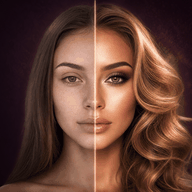
 Try this styleon your selfie · free
How to Find Your Undertone in 3 Quick Tests
Published July 17, 2026
Three at-home tests that finally tell you whether you're warm, cool, or neutral so every color choice gets easier.
Undertone vs. Surface Color: Know the Difference
Your surface color is what you see when you tan or flush; your undertone is the constant hue underneath that never changes, even when you get darker in summer. There are three: warm (golden, peachy, yellow), cool (pink, red, bluish), and neutral (a balance of both). This matters because two people can look the same shade of "medium" yet need completely different foundations, hair colors, and lipsticks. Surface color tells you depth, undertone tells you direction. When your foundation looks slightly orange or ashy by midday, that's almost always an undertone mismatch, not a shade-depth problem. Once you lock in your undertone, shopping stops being guesswork. You'll know within seconds whether a gold dress or a silver one will make your skin glow, and why some "universal" shades just never worked on you.
Test 1: The Vein Check in Natural Light
Walk to a window with real daylight, since indoor bulbs throw off yellow or blue casts that ruin the read. Flip your wrist over and look at the veins on the inside, where skin is thinnest. Green-looking veins point to a warm undertone, blue or purple veins point to cool, and a mix you genuinely can't decide on usually means neutral. The trick people skip is the lighting; do this near noon, not under a bathroom vanity. If your skin is deep and veins are hard to see, check the inner forearm instead. This test is fast and free, but it's not gospel on its own, that's why we run three. Treat it as your first data point, then confirm it against the next two before you commit to a verdict.
Test 2: The Jewelry and White-Fabric Test
Grab a gold necklace and a silver one, then hold each against your bare, makeup-free face near a window. Warm undertones look healthier and lit-up in gold; cool undertones brighten next to silver, while the other metal looks slightly off or dulling. Neutral skin honestly looks great in both, which is its own useful answer. For a second read, drape a pure-white shirt under your chin, then swap it for an off-white or cream one. If stark white makes you look fresh and the cream looks sallow, you lean cool; if cream flatters and bright white looks harsh, you lean warm. Do these back to back so your eye can compare. This test is my favorite because the difference is usually obvious the instant you switch.
Test 3: The Sun Reaction and White-Paper Read
How your skin behaves in sun is a strong undertone clue. If you burn fast, go pink, and rarely tan, you're likely cool; if you tan easily to a golden or olive brown and rarely burn, you skew warm. People who tan but also pinken first often land neutral. Pair this with the paper test: hold a sheet of plain white printer paper right up to your bare face in daylight. Against that hard white reference, your skin will read either yellow/golden (warm), pink/rosy (cool), or grayish-balanced (neutral). The paper removes guesswork because it gives your eye a true white to compare against. Run all three tests, then go with the answer that showed up at least twice, that's your real undertone, not a one-off fluke.
What to Do Once You Know
Your undertone becomes a shopping shortcut. Warm skin glows in golden blondes, caramel, copper, warm browns, and lipsticks in peach, coral, brick, and terracotta; gold jewelry is your friend. Cool skin sings in ash blonde, espresso, jet black, plum, and berry, rose, and blue-red lips, with silver metals. Neutral folks can borrow from both, so chase depth and vibe over rigid rules. For foundation, match the undertone first then the depth, looking for labels marked W (warm/yellow), C (cool/pink), or N (neutral). Bring this knowledge to blush too: peach and warm coral for warm, cool pink and mauve for cool. The payoff is fewer returns and that "your skin looks amazing today" effect, because everything finally agrees with what your face was always doing underneath.
Common Mistakes That Give a False Read
The biggest one is testing under bad light; warm bathroom bulbs make everyone look golden and LED office lights flatten everything. Always use a north-facing window or step outside. Mistake two is testing with makeup, self-tanner, or a fresh sunburn on, all of which mask your true undertone, so go bare-faced. Mistake three is trusting a single test; the vein check alone fools plenty of people, which is exactly why we triangulate with three. Also, don't confuse depth with undertone, you can be fair and warm or deep and cool. If you preview new hair colors and makeup on your own selfie in GlowMaxing first, you can see your undertone match play out before you buy or book anything. Run the tests, confirm, then experiment with total confidence.
The quick checklist
- Always test in natural daylight near a window, never under warm bulbs
- Go fully bare-faced with no makeup, self-tanner, or sunburn
- Run all three tests and trust the answer that shows up twice
- Gold flatters warm, silver flatters cool, both work for neutral
- Match foundation to undertone first, then to depth
- Use a sheet of white paper as a true reference against your face
- Warm tans easily, cool burns fast, neutral does a bit of both
✦ Free to start✨ Try these looks on your own selfie with GlowMaxing →Upload one selfie and try any hairstyle, color or makeup look instantly with AI. Free to start.Download on theApp Store